
Config
Configuration
04Quantitative Risk Research Platform
An auditable research platform for portfolio risk, regime diagnostics, stress testing, and chronologically valid strategy evaluation.
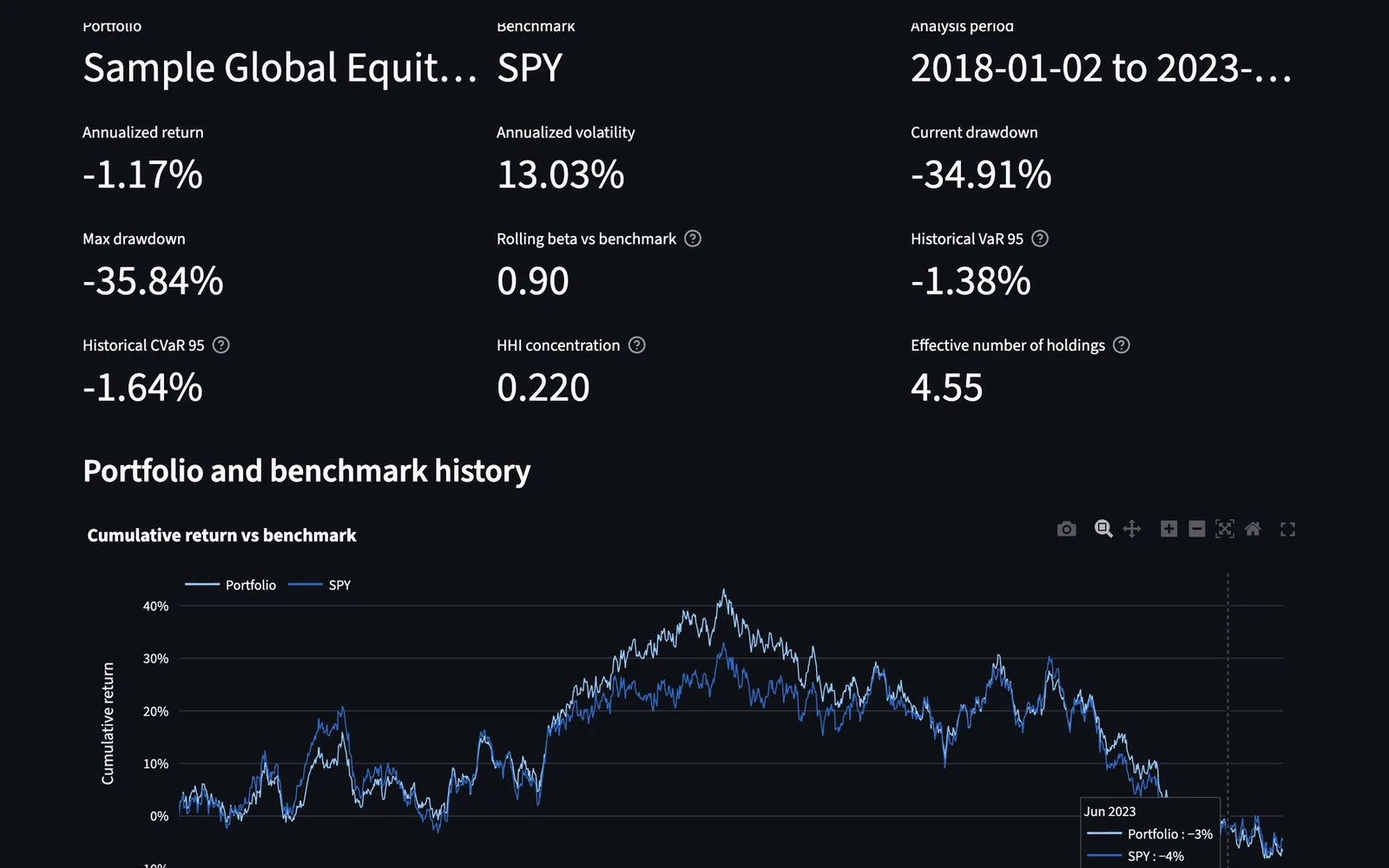
Research interface on the bundled sample portfolio; results are illustrative and not investment advice.
Builds validated ETF research datasets, estimates portfolio and tail risk, compares multiple regime-detection approaches, runs defined stress scenarios, and evaluates shifted, cost-aware strategies without presenting the output as investment advice.
Quantitative research becomes difficult to trust when data validation, feature construction, model fitting, signal timing, transaction costs, and reporting are scattered across notebooks. The project packages those stages into an inspectable workflow whose assumptions and failure modes can be reviewed.
Designed and implemented the end-to-end research platform, including dataset construction, portfolio analytics, regime features and models, stress testing, backtest controls, reporting, automated tests, CI, and the Streamlit interface.
Config
Configuration
Ingest
Data ingestion
Validate
Data validation
Features
Feature + risk layer
Regimes
Regime research
Stress
Stress engine
Backtest
Backtest lab
Report
Reporting
Proof
Validation
322
Automated checks in the CI matrix
Latest successful main-branch CI run 32056520339 (2026-08-17): 322 checks on each of Python 3.12, 3.13, and 3.14; rechecked 2026-08-18.
Point-in-time count, not a live counter.
9
Streamlit research pages in the application
Counted from the checked-in application navigation; repository state rechecked 2026-08-18.
5
Regime-detection approaches compared
Threshold, K-means, Gaussian mixture, hidden Markov, and change-point methods in the checked-in implementation.
A reproducible research environment that brings portfolio diagnostics, regime analysis, stress tests, and cost-aware backtesting into one inspectable workflow. The value is the research discipline and testability, not a forecasting edge.
Data and privacy
Runs on a configured ETF universe and a tracked synthetic dataset. No personal holdings, brokerage credentials, or account data are involved.